Repair
Replacement
Signs Your Siding Needs Repair or Replacement
How to tell which signs point to a quick fix and which ones mean it’s time for new siding — built around how Louisiana and Florida heat, humidity, and storms actually wear down a home’s exterior.
Siding plays a critical role as a home’s first line of defense against weather, and not every damaged panel means a full tear-off — but not every “small” problem stays small once humidity and storm season get involved.
Knowing the real warning signs is what separates a quick fix from a much bigger bill later. This guide walks through the real signs siding needs repair or replacement, framed as a siding repair vs replacement decision split clearly into two lists: what usually calls for a patch job, and what calls for new siding. Along the way, we cover siding storm damage signs specific to the Gulf South, how to tell if siding needs replacing before it costs you in energy bills or interior damage, and what a hail damage siding inspection should actually check after a named storm rolls through New Orleans or Destin.
Lifespan Reality Check
How Long Does Siding Actually Last in Louisiana & Florida Heat and Humidity?
Every siding material has a lifespan number printed in its marketing material, and almost none of those numbers were tested against a New Orleans summer or a Destin hurricane season.
Typical Lifespan by Material (Vinyl, Fiber Cement, Wood, Engineered Wood)
Vinyl siding commonly lasts 20 to 30 years, though a lot of that range depends on sun exposure and installation quality rather than the material alone. Fiber cement siding, the material behind most HardiePlank installs, is rated for 30 to 50 years and holds up well against heat swings without warping or cracking under normal conditions. Traditional wood siding, cedar especially, can reach 20 to 40 years with regular repainting and sealing, though homeowners who skip that upkeep see failure much sooner. Engineered wood siding often carries a 50-year limited substrate warranty, but the realistic service life tends to run closer to 20 to 30 years, especially once the factory finish gets skipped during a repaint cycle. None of these figures are guarantees — they’re averages, and actual lifespan depends on the specific product, installation quality, and how much maintenance the siding actually gets.
Why HZ10 Humidity Wears Siding Differently Than Freeze-Thaw Climates
Most of these lifespan numbers come from testing built around freeze-thaw cycling, the kind of damage siding takes in a climate with a real winter. New Orleans and Destin barely see a hard freeze. Instead, siding here deals with sustained humidity almost year-round, intense UV exposure, and hurricane-force wind and rain most years — a different aging pattern than what those national numbers were built around. That’s part of why James Hardie rates its HZ10 product line specifically for high-humidity, high-heat coastal climates like this one, rather than relying on a single national spec for every region.
| Material | Typical Lifespan | Watch For |
|---|
| Vinyl | 20–30 years | Heat buckling, brittleness |
| Fiber Cement | 30–50 years | Butt-joint cracking, cut-edge wicking |
| Wood (Cedar) | 20–40 years | Rot, soft spots, repaint upkeep |
| Engineered Wood | 20–30 years | Finish failure, moisture swelling |
Repair Signs
Signs You Need Repair, Not Full Replacement
Not every problem on a siding wall means the whole wall has to come off. Your current siding may just need a targeted fix in one spot — these three signs usually point to a repair, not a full replacement.
A Single Cracked, Chipped, or Impact-Damaged Panel
A single panel damaged by a dropped ladder, a stray baseball, or a small branch is usually a repair, not a replacement — as long as the rest of the wall is sound.
What Counts as “Isolated” vs. Spreading Damage
Isolated damage stays in one section: one panel, one small area, with no soft spots, discoloration, or gaps spreading outward from it. Spreading damage shows up as cracks branching outward, softness in the panels next to the original damage, or staining that widens over a few months — signs the problem has already moved past the original panel.
When a One-Panel Swap Is Genuinely Enough
If the surrounding panels test firm, match in color, and show no separate signs of moisture, one or two panels can usually be swapped without touching the rest of the wall. Matching an older color exactly can be harder than the repair itself, especially on sun-faded siding, so expect a slight color difference on an older wall until the whole side gets repainted or replaced.
A Loose Panel or Failed Caulk Joint
A panel that’s come loose at one corner, or a caulk joint that’s cracked and pulled away, is a common and usually minor repair — if it’s caught before water gets behind the wall.
Why Humidity Makes Small Gaps Fail Faster Here Than Up North
Constant humidity and heat cycling make caulk and sealant break down faster in the Gulf South than in a drier, more moderate climate, so a small gap that might last several seasons elsewhere can start letting water in within a single humid summer here.
Quick Fixes That Actually Hold in Gulf Coast Conditions
A loose panel typically just needs re-securing to the wall, and a failed caulk joint needs the old caulk fully removed and replaced with a sealant rated for high-humidity, high-UV exposure — a standard exterior caulk not built for this climate tends to fail again within a year or two.
Minor Fading or a Small Area of Peeling Paint
Fading and small peeling spots are cosmetic issues on their own, and a fresh coat of paint often solves the problem completely.
When a Fresh Coat Still Solves the Problem
If the siding underneath the peeling paint is still solid, dry, and free of soft spots, repainting restores both the look and the protective layer, and it’s the more budget-friendly option compared to full replacement.
The Point Where Repainting Stops Being Cost-Effective
Once paint won’t hold for more than a season or two even after proper prep, or once chalking and fading cover most of the wall rather than one section, repainting starts costing close to what partial siding replacement would cost, without solving the underlying problem.
Replacement Signs
Signs You Need Full Replacement
These signs point to a bigger problem than a patch or a paint job can fix — the siding itself has stopped doing its job, and it’s time to replace your siding rather than keep patching it. Knowing when to replace instead of repair usually comes down to how many of these signs show up at once, and how far each one has spread.
Rot, Soft Spots, or Spongy Panels
Rot rarely stays contained to the spot where it started, and once a panel feels soft, the material underneath has usually already lost its structural strength — left alone long enough, it can turn into real structural damage to the wall behind the siding panels.
The Screwdriver Test
Pressing a screwdriver tip gently into a suspect panel is a simple way to check for rot — solid siding resists the pressure, while rotted material gives way easily or crumbles. Finding soft spots in more than one or two isolated locations is usually a sign the rot has spread further than what’s visible on the surface.
Why Hidden Rot Spreads Faster in Constant Humidity Than in Seasonal Freeze-Thaw
Rot needs sustained moisture to spread, and New Orleans’ year-round humidity keeps wood and wood-based siding wetter for longer stretches than a climate with a dry winter season, which is part of why hidden rot behind siding tends to progress faster here once it starts.
Warping, Buckling, or Panels Pulling Away from the Wall
Warped or buckled panels have lost their original shape, and once that happens, the siding can’t seal the wall the way it’s designed to anymore.
Vinyl Expansion in Extreme Heat vs. Moisture-Driven Warping
Vinyl siding can buckle from heat expansion alone, particularly on walls that get intense afternoon sun, while wood and engineered wood siding more commonly warp from trapped moisture swelling the material unevenly. Both problems look similar from the street but come from different causes.
Why Panels Can’t Be Re-Secured Once They’ve Lost Their Shape
A warped panel has physically changed shape, so re-nailing or re-securing it doesn’t restore a flat surface — it just holds a bent panel in place, and gaps usually reopen within a season or two.
Recurring Mold, Mildew, or Fungus Growth
Mold that keeps coming back after cleaning is a different problem than mold that wipes off and stays gone.
Surface Mold You Can Clean vs. Mold in the Wall Cavity
Surface mold and mildew on the outside of the panel usually washes off with a standard cleaning and doesn’t return for months. Mold that reappears within weeks, especially in the same spot, often means moisture is trapped behind the siding, feeding mold growth in the wall cavity itself — a problem a surface cleaning can’t reach.
Why New Orleans Humidity Keeps Wall Cavities Wet Longer Than Drier Climates
Once moisture gets behind siding in a climate this humid, it has far less chance to fully dry out between rain events than it would somewhere with lower year-round humidity, which is why recurring mold here is more often a sign of a deeper moisture problem than simple surface grime.
Blistering or Bubbling Beneath the Surface
Bubbles or blisters under paint or siding film mean something is pushing from underneath the surface, and that something is almost always moisture or heat.
What Trapped Moisture Under the Surface Actually Means
A blister forms when moisture has been trapped beneath the paint or finish and tries to escape, pushing the surface layer up from below — which means the moisture problem exists whether or not the blister itself ever pops.
Sun Exposure vs. Water Intrusion as the Root Cause
Blistering on a wall with heavy, direct afternoon sun can sometimes trace back to heat alone, but blistering on a shaded wall, or blistering paired with any soft spots nearby, usually points to water intrusion as the real cause.
Most Urgent SignInterior water stains, damp drywall, or peeling wallpaper near an exterior wall mean moisture has already worked its way through the siding, the weather barrier, and the sheathing — act on this one first.
Interior Signs — Water Stains, Peeling Wallpaper, Damp Drywall
By the time siding failure shows up inside the house, the damage has usually been building for a while.
How Far the Damage Usually Extends by the Time It Shows Up Inside
Water stains, damp drywall, or peeling interior wallpaper near an exterior wall usually mean moisture has already passed through the siding, the weather barrier behind it, and the wall sheathing — which means the visible interior spot is rarely the full extent of the damage.
Why This Is the Most Urgent Sign to Act On
Interior moisture signs are the clearest signal to act quickly, since insulation, framing, and drywall can all be absorbing moisture out of sight, and the longer it goes unaddressed, the more of the wall assembly needs to be opened up and repaired.
Widespread Fading, Chalking, or Paint That Won’t Hold Anymore
A powdery residue on siding that transfers onto your hand is a specific, well-understood sign, not just old paint.
Chalking as a Sign UV Stabilizers Are Depleted
That powdery chalk residue means the paint or finish’s UV stabilizers have broken down from years of sun exposure, and the surface layer has started to break apart at a microscopic level. Light chalking on an older coating is a normal part of aging, but heavy chalking across most of the wall means the coating has stopped protecting what’s underneath it.
When Repainting No Longer Restores Protection
Repainting over heavy chalking without fully cleaning and priming the surface first tends to fail quickly, since new paint won’t bond well to a chalky layer — and if chalking covers most of the house rather than one wall, that’s usually a sign the whole exterior has reached the end of its usable finish life.
Rising Energy Bills Without Another Explanation
An unexplained jump in heating and cooling costs is one of the least obvious signs of failing siding, and one of the easiest to overlook.
How Gaps and Failing Seals Let Conditioned Air Escape
Gaps, warped panels, and failed caulk joints all give conditioned air a way to escape and let outside heat and humidity in, which hurts the whole home’s energy efficiency and makes the heating and cooling system work harder to hold the same indoor temperature — and that shows up as a steady climb in energy bills rather than a sudden spike.
Ruling Out Windows and HVAC First
Before blaming siding for an energy bill increase, it’s worth ruling out windows, attic insulation, and the HVAC system itself, since all three can cause the same symptom. If those check out and the siding shows any of the gaps, warping, or failed seals described above, the siding is a reasonable next place to look.
Formosan Termite and Pest Entry Points
Damaged siding doesn’t just look bad — in this region, it opens a door for one of the most destructive pests in the country.
Why Formosan Subterranean Termites Are the Defining Risk in New Orleans Homes
Formosan subterranean termites are widely considered the most destructive insect pest in Louisiana, and Orleans Parish has operated under a state quarantine for the species for years because of how aggressively it spreads. Gaps, cracks, or rotted sections in siding give these termites an easy entry point into wall framing that a solid, well-sealed exterior wouldn’t offer.
What Termite Damage Behind Siding Actually Looks Like
Termite damage often isn’t visible from the outside until it’s advanced — small mud tubes near the base of a wall, hollow-sounding wood when tapped, or soft, crumbling wood behind a damaged siding section are the more common signs, and any of them are worth a professional inspection rather than a guess.
Fiber Cement-Specific Signs: Cracking at Butt Joints and Moisture Wicking at Cut Edges
Fiber cement siding, including HardiePlank, holds up well overall, but it has its own specific failure points that don’t show up on a generic vinyl or wood damage checklist.
What Causes Cracking at Butt Joints
Cracking where two boards meet end-to-end usually traces back to missing or improperly installed flashing behind that joint, which lets water reach the wall sheathing directly. Boards installed without enough gap for natural expansion can also crack at these joints over time, since the material has nowhere to move as temperatures shift.
Why Unsealed Cut Edges Act Like a Straw for Water
Every cut edge on a fiber cement board needs to be sealed with a compatible primer or sealant, since an unsealed edge absorbs water almost like a straw, causing the board to swell, the paint to fail, and in humid conditions, mold to develop inside the material itself. This is one of the more common installation-quality issues a professional inspection catches that a homeowner walking the yard usually wouldn’t.
Wind-Driven Rain and Storm-Related Failure
Named storms test siding in a way that everyday weather doesn’t, and the damage isn’t always obvious right after the storm passes.
Post-Storm Inspection Points After Named Storms
After a named storm, it’s worth checking siding for cracked or missing panels, seams that have separated, and any staining that suggests wind-driven rain got behind the wall during the highest-wind hours. Since roofing, gutters, and siding all take wind and water stress from the same storm at the same time, a single coordinated exterior check after a hurricane or tropical storm catches problems a siding-only look can miss — a loose gutter section or a lifted shingle edge can just as easily be the reason water is getting behind siding lower on the wall.
Why a Seam That Keeps Failing After Every Storm Is a Replacement Signal, Not a Repair One
A seam or joint that gets repaired after one storm and fails again after the next one usually means the underlying installation or material has a problem that a repeated patch job won’t fix — at that point, replacing the affected section, or the wall as a whole, is the more reliable long-term answer.
Repair TerritoryOne Spot, Contained
One cracked panel, a loose section, a small area of peeling paint — isolated, not spreading.
Replacement TerritoryWidespread, Recurring
Rot, warping, recurring mold, chalking, interior moisture signs, or damage that keeps coming back.
Regional Differences
New Orleans vs. Destin/Emerald Coast: Different Risks, Different Signs
The same siding material can fail for different reasons depending on which side of the Gulf it’s installed on.
Humidity and Termite Pressure Inland (New Orleans)
In New Orleans and the surrounding parishes, sustained humidity and Formosan termite pressure are the dominant risks — the signs to watch closest are recurring mold, hidden rot, and any gap or crack that could give termites an entry point into the wall.
Salt Air, Wind-Driven Rain, and Storm Exposure on the Coast (Destin/Emerald Coast)
Along Destin and the Emerald Coast, salt-laden air, direct hurricane exposure, and wind-driven rain do more of the damage — homeowners here should pay closer attention to caulk and seal failure, wind-driven water intrusion at seams, and any finish degradation that shows up faster this close to the water.
New OrleansHumidity + Termites
Recurring mold, hidden rot, and gaps that give Formosan termites an entry point are the signs to watch closest.
Destin / Emerald CoastSalt Air + Storm Exposure
Caulk and seal failure, wind-driven water intrusion at seams, and faster finish degradation near the water.
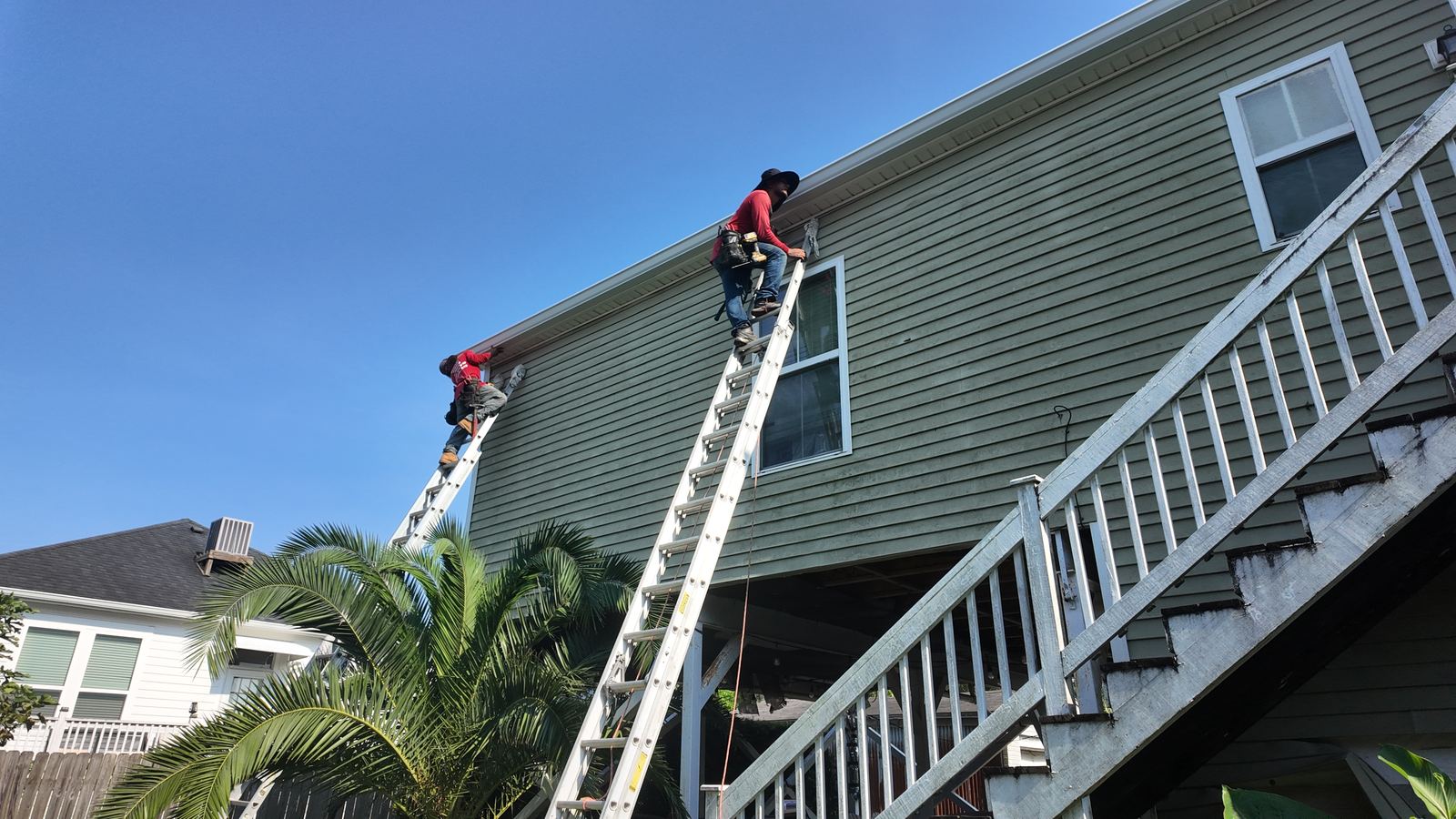
A coordinated check of siding, roofing, and gutters after a storm catches problems a siding-only look can miss.
Age Check
How Old Is Your Siding? Age as an Early Warning Sign
Age alone doesn’t mean siding needs to be replaced, but it’s a useful early flag, especially once a wall is approaching the upper end of its expected lifespan.
Expected Lifespan by Material — and Why Gulf Coast Homes Often Fall Short of It
Siding installed 20 or more years ago is worth a closer look even without obvious damage, since materials rated for 30 to 50 years under average national conditions often show wear sooner in a climate with this much heat, humidity, and storm exposure. Checking siding age against the signs covered above is a reasonable way to decide whether an inspection is overdue.
One damaged panel is usually a repair. Rot, recurring mold, or water inside the house is usually a replacement.
Frequently Asked Questions
How Do I Know If It's Repair or Full Replacement?
Isolated damage — one cracked panel, one loose section, a small area of peeling paint — usually points to repair. Widespread rot, warping, chalking, interior moisture signs, or damage that keeps recurring after repairs usually means the material has reached the end of its useful life and full replacement is the more reliable option.
How Long Does Siding Really Last in Louisiana/Florida Heat and Humidity?
Vinyl typically lasts 20 to 30 years, fiber cement 30 to 50 years, wood 20 to 40 years with regular maintenance, and engineered wood around 20 to 30 years in practice. Gulf South heat, humidity, and storm exposure often push real-world lifespan toward the shorter end of these ranges compared to milder climates.
Are Formosan Termites Really Different From Regular Termites?
Formosan subterranean termites form larger colonies and cause damage faster than most native termite species, which is why Orleans Parish has been under a state quarantine for the species. Any gap or damaged section in siding gives them an easier way into a home’s wall framing.
Should I Replace Siding Right After a Hurricane, or Wait?
It depends on what an inspection finds. Isolated wind or debris damage can often be repaired, but a coordinated check of the roof, gutters, and siding together after a named storm is the best way to catch water intrusion that isn’t obvious from a siding-only look, before it turns into a bigger repair.
Does New Siding Help With Energy Bills in a Hot, Humid Climate?
Yes, in most cases. New siding closes the gaps, failed seals, and warped sections that let conditioned air escape, which reduces the load on the HVAC system. It’s not usually the first thing to check for high energy bills, but it’s worth ruling in or out once windows and HVAC have been checked first.
Get a Free Siding Inspection in New Orleans or Destin
Once siding is one of the areas showing real wear, it’s worth acting before it loses more of its ability to defend the house against weather. Addressing siding issues early — while it’s still a repair, not a full replacement — protects your home, keeps energy bills in check, and holds onto curb appeal that matters if you ever sell. Siding replacement can be done section by section or as a full home improvement project, depending on how far the damage has spread. Our team offers full exterior assessments that check siding, roofing, and gutters together, since storm and moisture damage rarely shows up in just one place.