Roofing / New Orleans & Destin
Signs You Need a Roof Repair vs. Full Replacement
The exact signs to check from the ground, the attic, and inside your house — plus the cost math that settles repair vs. replacement for good.
30% - 35%
(approximately)
The rough threshold where repair cost stops making sense and replacement takes over.
A single missing shingle after a windstorm doesn't mean much on its own. A roof with granule loss, a soft attic deck, and a water stain on the ceiling all at once is a different story entirely, and knowing which situation you're actually in is the whole roof repair vs replacement decision.
Your roof is one of the few components of a house that fails quietly. A damaged roof rarely announces itself the way a broken water heater does. Instead it shows up as a handful of small, easy-to-dismiss signs your roof needs attention, spread out over months or years, until enough of them stack up that the answer becomes obvious.
Your roof plays a bigger role in the house than most homeowners give it credit for. It's your home's first line of defense against wind, rain, hail, and sun, and every other system in the house — insulation, drywall, electrical runs in the attic — depends on that first line of defense holding. Common signs of a failing roof tend to show up in the same few places every time, which is exactly why this guide is organized the way it is.
This guide walks through the signs you can see, the ones hiding where you'd never think to look, and the cost math that settles the question either way. By the end, you should have a clear sense of whether your roof needs repair or replacement — and if it's genuinely unclear, a professional inspection is the fastest way to get a real answer instead of guessing.
None of these signs by themselves is a definitive warning sign that you need a whole new roof. A roof could show one or two of them and still have years of useful life left. It's the combination, and how quickly new ones keep appearing, that usually tells the real story.
Zone 00 — Quick Answer
Quick Answer: Repair or Replace?
Most roof problems fall into one of two clear categories once you know what to look for. Here's the short version before the full breakdown below.
When Repair Is Usually Enough
A repair is usually enough when the damage is isolated: a handful of missing shingles, one damaged flashing detail, a single leak with an obvious cause. If the rest of the roof system is still within its expected lifespan and shows no widespread granule loss, a simple repair typically solves the problem.
Many homeowners assume any leak means the entire roof needs replacing, and that's rarely true. A roofing contractor can usually trace a single leak back to one failure point — a cracked pipe boot, a lifted shingle, a gap in flashing — and close it without touching the rest of the roof.
When Replacement Is the Smarter Investment
Replacement becomes the smarter investment once damage is spread across multiple sections of the roof, or the roof is already nearing the end of its lifespan. A roof that's racked up several repair calls in the past two years is usually telling you something a single patch won't fix.
If your roof is approaching or past its material's expected service life, it's often time to replace your roof proactively rather than wait for a failure that forces the issue during a storm. Replacing on your own schedule, with a chosen contractor and a planned budget, beats an emergency tear-off after a leak has already damaged the drywall below.
A homeowner who needs a new roof entirely usually sees more than one of the signs covered in this guide at the same time — say, curling shingles across several slopes plus a soft spot in the attic decking. When that combination shows up, it's time to replace rather than schedule another round of patchwork, since a roof may need a replacement even if no single sign looks dramatic on its own.
The 30% Damage Rule
A widely used rule of thumb in the roofing trade holds that if repair costs climb above roughly 30% of what a full roof replacement would cost, replacement is the better value. Some contractors use a 50% threshold instead, but 30% is the more common line for advising homeowners on an older roof.
Either way, the rule exists because repeated repairs on a roof that's already old rarely turn out to be the cheaper path once you add them all up. Three or four repair invoices at a few hundred dollars each can quietly approach what a section replacement would have cost, without ever solving the underlying problem.
Repair — Usually EnoughIsolated damage, one clear cause, roof still within its expected lifespan. A roofing contractor closes the single failure point and moves on.
Replace — The Smarter MoveDamage spread across multiple sections, several repair calls in two years, or a roof already near the back end of its lifespan. Repeated patchwork rarely beats scheduling the replacement.
Zone 01 — Ground Level
Signs You Can Spot From the Ground
Some of the clearest red flags don't require a ladder at all. A pair of binoculars and a walk around the house catches most of what matters, and these are the common signs worth checking every season.
Missing, Cracked, or Curling Shingles
Missing shingles leave a bare patch where water has a direct path to the roof deck. Cracked or curling shingles mean the asphalt has dried out and lost its flexibility, which is a sign of age more than storm damage in most cases.
A few damaged shingles after one storm is a repair. Curling or cracking spread across large sections of the roof is a sign the whole roof is nearing the end of its service life, and it usually hurts curb appeal well before it causes an actual leak.
Most asphalt shingle roofs last 15 to 20 years before this kind of widespread wear sets in. If your roof is reaching that range and shingles across multiple slopes are curling at the edges, that's a stronger signal than one or two shingles blown off in a single storm.
Granules Collecting in Gutters
Granules are the protective coating baked onto asphalt shingles, and losing a few after a hard rain is normal. Granules piling up in gutters and downspouts every time it rains is a different story — it usually means the shingles have worn down past the point of good UV protection.
Heavy rain accelerates this process by physically washing loose granules off an already-thinning shingle surface. A homeowner who checks gutters after every significant rain event will usually notice the trend building well before any visible leak develops.
Sagging or Wavy Rooflines
A sagging roofline is a red flag that points to structural damage, not a cosmetic issue. Prolonged water intrusion weakening the roof deck is the most common cause, and a sagging roof should get a professional inspection right away rather than wait for the problem to get worse.
Structural issues like a sagging ridge or a wavy plane across one section of roof rarely resolve with a patch repair. In most cases the decking underneath has already absorbed enough water that the affected section, and often the entire roof structure around it, needs to come off down to the framing.
Moss, Algae, or Mold Growth
Black streaking, green algae, and actual moss are common in humid climates, and they're worth checking even when the roof looks structurally fine otherwise. Moss in particular works its way under shingle edges and lifts them, turning a cosmetic issue into an active leak within a single rainy season.
Severe weather with repeated heavy rain and little drying time in between makes this worse than it would be in a drier climate. A roof that stays damp for days after a storm gives moss and algae exactly the conditions they need to spread.
Ground-level checks are worth doing on a regular schedule rather than only after a storm. A quick pass every few months, especially heading into and coming out of hurricane season, catches slow-developing problems before they turn into an emergency call.
It's also worth photographing the roof from a few consistent angles each time you check it. Side-by-side photos taken months apart make it much easier to tell whether curling, staining, or granule loss is actually getting worse or simply looks the same as it always has.
!
Curling & Missing Shingles
Bare patches and dried, curling asphalt across several slopes — a sign the roof is nearing the end of its service life.
!
Granule Buildup in Gutters
Granules washing into gutters every rain means the shingle surface has worn past good UV protection.
!
Sagging Roofline
A visible dip or wave almost always points to a weakened roof deck, not a cosmetic issue.
!
Moss, Algae & Mold
Moss lifts shingle edges from underneath, turning a cosmetic problem into an active leak within one rainy season.
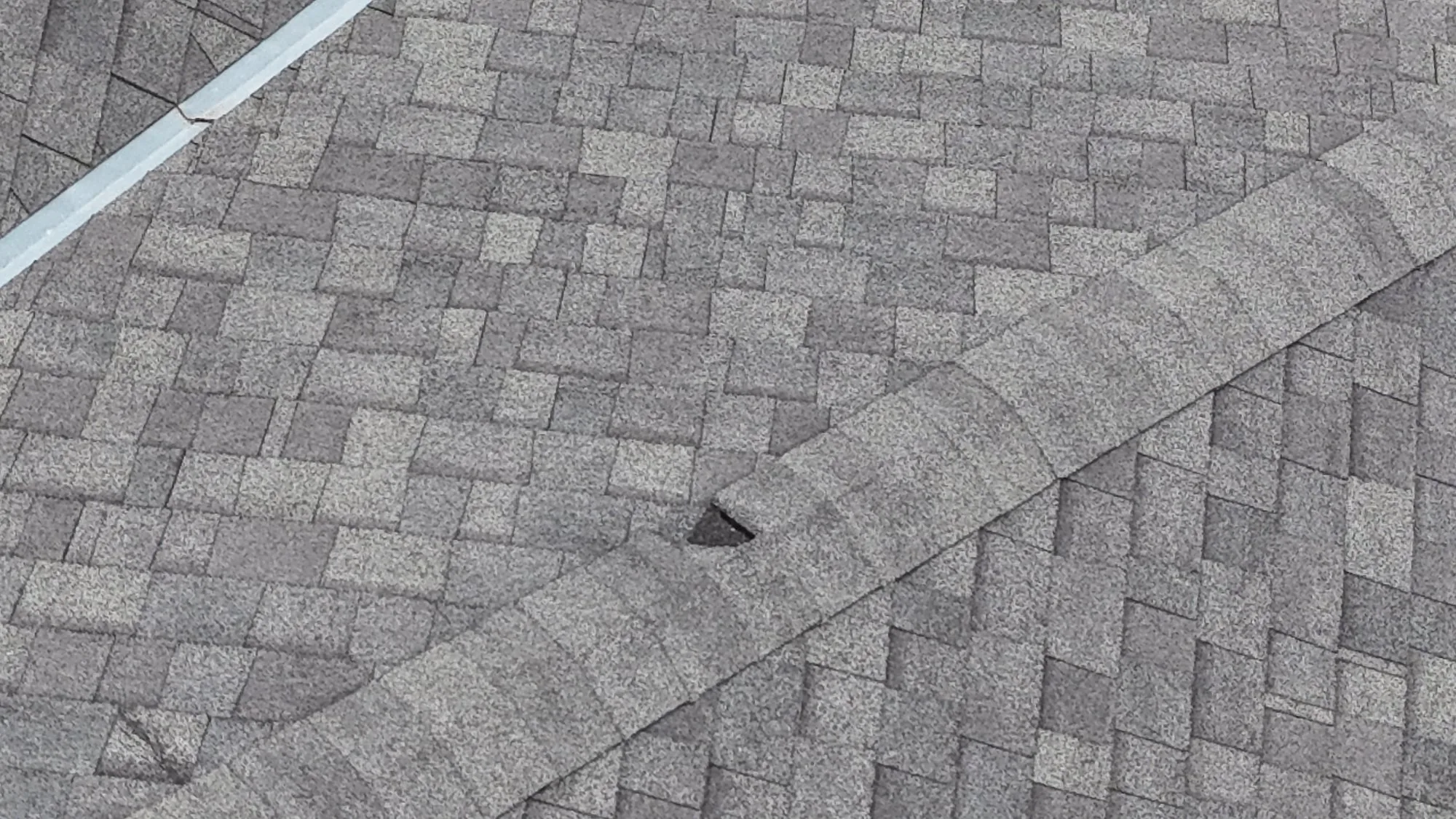
A torn shingle near the roof ridge — damage like this on even one slope is often a sign the whole roof, not just a shingle, needs a closer look.
Zone 02 — Attic
Signs Hiding in Your Attic
The attic tells you things the roof surface can't, and a flashlight and ten minutes is often all it takes to catch a problem early — before common signs on the surface ever appear.
Daylight Through the Roof Boards
Visible daylight through the roof boards means there's a gap somewhere that water can also get through. This is one of the more obvious signs of roof damage once you know to look for it, and it's often missed simply because most homeowners never go up there.
Any point where you can see daylight is a point where wind-driven rain could also be getting in, even if no stain has shown up on the ceiling yet. It's worth checking the attic after any storm with sustained high winds, not just after a visible leak.
Water Stains or Damp Rafters
Water stains or damp rafters in the attic point to a leak that hasn't reached the living space yet, which is actually the best time to catch it. Water travels sideways along framing before it shows up as a ceiling stain, so the actual leak point in the attic can be several feet from where the damage eventually appears below.
A roof leak found at this stage is almost always a repair, not a replacement, provided the rest of the roofing material around it is still sound. Left unaddressed for a year or two, the same leak can rot enough decking that it turns into a much larger job.
Musty Odors or Visible Mold
A musty smell in the attic usually means moisture has been sitting somewhere for a while, even if you can't see it yet. Visible mold on the underside of the roof deck or on insulation is a stronger sign, and it often points to a ventilation problem as much as a roof leak.
Mold doesn't always mean the roof itself has failed — sometimes it's simply a ventilation and insulation issue trapping humid air in the attic. Either way, a professional inspection can tell the two apart, and neither one should be ignored once you notice it.
Roof Deck Bounce or Soft Spots
A roof deck that bounces or feels soft underfoot means the plywood or OSB sheathing has absorbed water and started to break down. This is one of the clearer signs that repair alone won't solve the underlying problem, since a soft deck usually needs to be replaced along with whatever's on top of it.
If soft spots are limited to one small area, that section may need to be replaced without touching the rest of the roof. If soft spots show up in multiple places across the deck, that's usually a sign the entire roof, not just the shingles, may need to be replaced.
01
Daylight Through Boards
A direct sign that wind-driven rain has a path in, even with no ceiling stain yet.
02
Damp Rafters or Stains
Water travels sideways along framing — catch it here and it's almost always a simple repair.
03
Musty Odor or Mold
Points to a leak, a ventilation problem, or both — worth a professional look either way.
04
Deck Bounce or Soft Spots
Spread across multiple spots, this is usually the clearest sign the whole roof, not just the shingles, needs work.
Zone 03 — Living Space
Signs Inside Your Living Space
By the time a roof problem reaches the inside of the house, it's usually been building for a while — these are signs your roof needs attention that most homeowners actually notice first.
Ceiling or Wall Water Stains
A brown ring on the ceiling or a stain creeping down an interior wall is one of the clearest signs your roof needs attention. A stain that reappears after a dry spell is a sign that your roof may have more than one failure point rather than a single simple leak.
Roof leaks that reach the ceiling have usually already traveled through insulation and decking, so even a small stain is worth a same-week inspection rather than a wait-and-see approach. A leaking roof left unaddressed through even one more heavy rain event can turn a $300 repair into a $3,000 one.
Unexplained Spikes in Energy Bills
A sudden jump in heating or cooling costs, with no other explanation, can mean a roof and attic ventilation problem is letting conditioned air escape. Energy efficiency and roof condition are more connected than most homeowners realize, since a compromised roof deck and poor attic ventilation both waste energy the same way a leaky window does.
This is one of the quieter signs of roof damage, since nothing looks obviously wrong from the ground or even from inside the attic at a glance. It's usually worth mentioning a recent bill spike to whoever performs your next roof inspection, since it can help narrow down where the problem actually is.
Peeling Paint or Wallpaper
Peeling paint or bubbling wallpaper, especially near the ceiling line, usually means moisture is trapped somewhere behind the wall. It's a slower, quieter sign than a water stain, but it points to the same underlying roof or ventilation issue.
Interior finish damage like this is almost never the roofing material's fault directly — it's a downstream symptom of a leak or ventilation problem that started at the roof and worked its way inward over time.
!
Ceiling & Wall Stains
A stain that reappears after a dry spell often means more than one failure point.
!
Rising Energy Bills
A quiet sign — a compromised deck and poor ventilation both waste energy the same way a leaky window does.
!
Peeling Paint or Wallpaper
A slower sign of trapped moisture behind the wall, tracing back to the same roof or ventilation issue.
Zone 04 — Components
Damaged Components That Signal Bigger Problems
Some of the most telling roof issues aren't on the shingles at all — they're in the metal and seals that tie the whole roof system together.
Deteriorating or Rusted Flashing
Flashing seals the joints where a roof meets a wall, chimney, or another roof plane, and it's usually the first thing to fail well before the shingles themselves do. Rusted or deteriorating flashing is a common cause of leaks that seem to come from nowhere, since the actual failure point is often several feet from where water shows up inside.
Flashing failures are almost always a straightforward repair, and catching one early is one of the best ways to protect your roof from bigger problems down the line. Left alone for years, though, a failed flashing joint can let enough water in to damage the decking around it, and at that point the fix grows well past a simple flashing swap.
Damaged Vents or Skylight Seals
Roof vents and skylights each have their own seal, and a cracked or shrunken seal around either one is a common, easy-to-miss leak source. These seals wear out well before the shingles around them do, which is why an inspection should always check them individually rather than assuming the shingles are the whole story.
A single failed vent seal is a quick, inexpensive repair. Several failed seals across a roof that's already old, on the other hand, often show up alongside other signs of roof damage and point toward a fuller job.
Rusted Roof Valleys
A roof valley carries more water than any other part of the roof, and rusted valley metal should get replaced before it fails outright rather than after. Salt air and humidity both accelerate this kind of corrosion, which matters more in a coastal market than it would somewhere drier.
Valley metal deteriorating is one of those roof issues that's easy to put off because the shingles right next to it can still look fine. Once the metal underneath rusts through, though, water gets under the shingles at exactly the point where the roof sheds the most volume, and that can escalate quickly during heavy rain.
Zone 05 — Roof Age
How Roof Age Factors Into the Decision
Age alone doesn't decide whether a roof needs repair or replacement, but it changes which answer makes financial sense.
Expected Lifespan by Material
Asphalt shingle roofs typically last 15 to 20 years in this climate, architectural shingles run 20 to 25, and metal, tile, or slate roofs commonly reach 30 years or more. A roof close to the end of its material's expected lifespan is a much weaker repair candidate than a five-year-old roof with the same isolated damage.
Knowing roughly how long asphalt shingle roofs last in a given climate helps set expectations early, well before any visible signs of roof damage show up. A homeowner who knows their roof is a 16-year-old asphalt shingle roof going into hurricane season can plan for a likely replacement rather than being surprised by it.
Why 15 vs. 20+ Years Changes the Math
A 15-year-old asphalt shingle roof with storm damage is often still a reasonable repair candidate, since it likely has several years of service life left either way. A 20-plus-year-old roof with the same damage is a different calculation entirely, since it's already close to replacement age and a repair only buys a year or two before the same decision comes up again.
Once a roof is approaching the back end of its expected lifespan, it may be time to start budgeting for a full roof replacement even if nothing has failed yet. Deciding to replace on your own timeline, rather than after an emergency leak, is almost always the cheaper and less stressful path.
A roof often gives fair warning before it fails outright — a run of small repairs, a rising energy bill, shingles that look tired in photos from a few years back compared to now. Once that pattern is clear, it's time to replace rather than keep chasing individual symptoms one at a time.
Multiple Existing Shingle Layers
Most residential codes allow a maximum of two layers of shingles on a roof, and a roof that's already been re-covered once can't legally get a third layer added on top. If your roof already carries two layers, the next job is a full roof replacement by code, not another overlay, regardless of how isolated the current damage looks.
This is one of the few situations where the decision isn't really a judgment call at all — it's a code requirement. An inspection should always confirm how many layers are already on the roof before anyone quotes a repair.
15–20 YRSAsphalt shingle roofs
20–25 YRSArchitectural shingles
30+ YRSMetal, tile, or slate
Zone 06 — Climate
New Orleans & Destin Climate Considerations
Louisiana and Florida homeowners are working with a different set of accelerants than most of the country, and the repair-or-replace math changes accordingly.
Hurricane Wind Damage vs. Ordinary Wear
Hurricane wind damage and ordinary wear-and-tear can look similar from the ground, but they call for different responses. A storm that lifts a dozen shingles across one slope, or drives wind-blown rain up under a ridge cap, is a distinct damage event that's often coverable under a homeowners policy — ordinary wear from age and UV exposure typically isn't.
Telling the two apart matters most right after a named storm, when it's tempting to assume every problem you find is storm-related. A roofing contractor who's done storm-damage assessments before can usually tell which cracked shingles are new and which were already failing before severe weather rolled through.
Humidity, Ventilation & Accelerated Mold
High humidity for most of the year means algae, mold, and moss all grow faster on a roof here than in a drier climate. Poor attic ventilation compounds the problem, since trapped moisture has nowhere to go and accelerates deterioration of both the roof deck and the insulation underneath it.
Roofing material that would deteriorate over 20 years in a dry climate can show real wear a few years sooner here, simply from constant humidity and heavy rain cycling through wet and hot conditions with little relief in between.
Salt-Air Corrosion Near the Coast
Homes near Lake Pontchartrain, the Gulf, or Destin's immediate coastline deal with airborne salt that corrodes exposed metal faster than it would even a few miles inland. Nails, flashing, and valley metal are the first things to show it, often years before a comparable inland roof would need the same attention.
Coastal homeowners should treat any rusted metal on the roof as a sign that needs a closer look sooner rather than later, since salt-driven corrosion tends to progress faster once it starts than it does in an inland climate.
FORTIFIED Roofs & Insurance Discounts
A FORTIFIED-standard roof upgrade brings more than storm resilience — it also brings a real insurance discount. Louisiana's Act 1 of 2023 requires every admitted carrier to offer a discount, typically in the 9 to 30% range, on the wind and hail portion of the premium for a roof that meets the FORTIFIED standard, with larger standardized discounts phasing in for policies issued after January 1, 2027.
The Louisiana Fortify Homes Program can help offset the cost of that upgrade, offering grants of up to $10,000 through periodic lottery rounds run by the Louisiana Department of Insurance. Florida homeowners work with a different mechanism: a wind mitigation inspection credits specific features like roof shape and deck attachment rather than one standard discount, so a Destin homeowner shouldn't assume Louisiana's rules carry over.
New Orleans, LA9–30% Off Wind/Hail
FORTIFIED-standard roofs qualify for a mandatory Act 1 discount from every admitted carrier, plus potential Fortify Homes Program grant funding.
Destin, FLWind Mitigation Credits
A wind mitigation inspection (form OIR-B1-1802) credits specific features individually rather than one flat standard discount.
Deciding to replace on your own timeline, rather than after an emergency leak, is almost always the cheaper and less stressful path.
Getting a second contractor's opinion is reasonable any time a quoted repair sounds larger than expected. A roofing contractor who suggests full replacement for what looks like a contained problem should be able to explain exactly why, in terms of the specific signs found during their inspection — not just a general recommendation to be safe.
Zone 07 — Cost
Repair vs. Replacement Cost Comparison
Cost is usually what turns "repair or replacement" from a technical question into a real decision.
Typical Repair Costs
Every dollar figure below is a national or regional average, not a quote — actual cost depends on your roof's size, access, and the extent of the damage. Request a free inspection for exact numbers on your property.
A simple shingle repair typically runs a few hundred dollars, while a more involved repair covering flashing, a section of decking, or a larger damaged area can run $1,000 to $3,000 or more. Repair costs climb fast once a roofing contractor has to open up decking to check for hidden water damage, and multiple small repairs across one roof can add up faster than homeowners expect.
Typical Replacement Costs
A full asphalt shingle roof replacement typically runs $9,000 to $18,000 depending on roof size and complexity, with metal, tile, or slate roofs costing considerably more per square foot but lasting two to four times as long. Historic-district compliance, a full tear-off, and hurricane-code wind-attachment requirements can all push replacement cost higher in this market specifically.
Replacement cost naturally scales with roof size and the number of penetrations — chimneys, skylights, vents — that each need their own flashing detail. A straightforward single-story roof with few penetrations sits at the lower end of that range, while a steep, complex roofline sits at the higher end.
Replacement may also cost more in a historic district, where matching materials and getting approval before work starts can add both time and expense to the project. It's worth factoring that into the budget early rather than discovering it partway through a permit application.
Return on Investment at Resale
National cost-vs-value data puts the return on a typical asphalt shingle roof replacement at roughly 60 to 70% of its cost recouped at resale, with the new roof itself commonly adding somewhere in the $15,000 to $21,000 range to a home's resale value. Figures vary by report and by local market, but a documented, recent roof consistently shows up as a selling point rather than a repair credit buyers negotiate against.
An older roof, by contrast, is one of the most common items a home inspector flags during a sale, and buyers in this market increasingly ask directly about roof age and FORTIFIED status before making an offer. Replacing before you list, rather than after an inspection contingency forces the issue, generally keeps more of that value in your pocket.
| Scenario | Typical Cost Range | What It Solves |
|---|
| Simple repair | $300–$1,000 | One isolated failure point — a leak, a shingle patch, a flashing seal |
| Involved repair | $1,000–$3,000+ | Flashing, decking section, or a larger damaged area |
| Full asphalt replacement | $9,000–$18,000 | Entire roof system, code-compliant, resets the lifespan clock |
Zone 08 — Inspection
What a Professional Inspection Checks
A professional roof inspection covers more ground than most homeowners expect, and it's worth understanding what's actually being checked before you inspect your roof yourself and assume that's enough.
Roof Surface
An inspector walks the roof checking for missing, cracked, or curling shingles, granule loss, damaged flashing, and any vents or skylight seals showing wear. The National Roofing Contractors Association recommends a professional inspection at least twice a year, in spring and fall, plus an additional check after any storm that produces hail or high winds.
Attic
From the attic, an inspector checks for daylight through the roof boards, water stains or damp rafters, soft spots in the decking, and whether the insulation and ventilation are doing their job. Many of the most serious roof problems are easier to catch from inside the attic than from the roof surface itself.
Written Report for Insurance
A thorough inspection ends with a written report documenting exact findings with photos, which matters as much for an insurance claim as it does for deciding between repair and replacement. An adjuster reviewing a claim wants to see specific, dated documentation, not a verbal description of what a contractor saw.
01
Roof Surface Check
Shingles, granule loss, flashing, vent and skylight seals — twice a year plus after any major storm.
02
Attic Check
Daylight through boards, damp rafters, soft decking, and whether insulation and ventilation are working.
03
Written Report
Dated documentation with photos — what an adjuster actually needs to process a claim.
Zone 09 — Insurance
Filing an Insurance Claim for Roof Damage
Storm damage and an insurance claim go together often enough that it's worth knowing the process before you actually need it.
What's Typically Covered
Sudden, storm-related damage — wind-lifted shingles, hail impact, a tree limb through the roof — is typically covered under a standard homeowners policy, subject to your deductible. Named storms usually trigger a separate, higher hurricane deductible, commonly 2 to 5% of the dwelling coverage amount, rather than your standard flat deductible.
What's Not Covered
Gradual deterioration from age, UV exposure, or lack of maintenance is typically excluded, since insurance covers sudden damage rather than expected wear. This is exactly why documenting a roof's condition before storm season matters — it's the difference between a covered claim and a denied one when an adjuster tries to draw the line between storm damage and pre-existing wear.
Tips for a Stronger Claim
Louisiana law gives policyholders 180 days after a hurricane or declared state of emergency to file a claim for storm damage, and that clock doesn't start running while access to the property is restricted. Photograph damage immediately, before any repair work starts, and get a professional inspection and written report as soon as it's safe to do so — GuttersTech can assess storm damage across roofing, gutters, siding, and soffit and fascia in one visit, which gives an adjuster a complete picture instead of four separate contractor reports.
Contractors familiar with GuttersTech's coverage area know which parishes and municipalities require additional permitting or documentation for roof work, and building that into an estimate up front avoids surprises once a project is already underway.
FAQ
How do I know if my roof needs repair or full replacement?
Isolated damage on a roof that's still within its expected lifespan is usually a repair. Damage spread across multiple sections, a roof nearing 20-plus years old, or repair costs above roughly 30% of full replacement cost all point toward replacement instead.
Can I put new shingles over old ones?
Most residential codes allow a maximum of two shingle layers. If your roof already has two layers, code requires a full tear-off rather than a third layer installed on top, regardless of how minor the current damage is.
How often should a roof be inspected?
The National Roofing Contractors Association recommends a professional inspection twice a year, in spring and fall, plus an additional check after any storm producing hail or high winds.
Will a new roof lower my insurance?
Often, yes. A FORTIFIED-standard roof qualifies for a mandatory discount under Louisiana law, typically 9 to 30% on the wind and hail portion of the premium, and many insurers also offer meaningful discounts simply for a newer roof regardless of certification.
What's the average cost difference between repair and replacement?
A simple repair often runs a few hundred to a few thousand dollars, while a full asphalt shingle replacement typically runs $9,000 to $18,000. The 30% rule of thumb exists precisely because that gap can close fast once repeated repairs are added up.
Not Sure If It's a Repair or a Replacement?
GuttersTech inspects roofs across New Orleans and Destin and gives you a straight, written answer — no upsell, just what your roof actually needs.