Micro-Mesh
Reverse Curve
Micro-Mesh vs. Reverse Curve Gutter Guards: Which Blocks Debris Better?
How each mechanism actually works, which one blocks more debris and handles heavier rain, how long each lasts, what each costs over 10 years, and which one wins for New Orleans and Gulf Coast homes.
Two gutter guard designs dominate the market, and they solve the same problem in almost opposite ways. Micro-mesh gutter guards filter debris out through a tightly woven screen, while reverse curve guards rely on a curved nose and the Coanda effect to guide water around a bend while debris drops off the front. Both count as legitimate gutter protection systems, but they perform very differently once you get past the sales pitch.
This guide compares micro-mesh vs reverse curve gutter guards on the things that actually matter on a working roof: how much debris each one actually blocks, how each performs once rain gets heavy, how long each one lasts, what each costs installed and cleaned over 10 years, and — the part most national buying guides skip entirely — how each performs against New Orleans' live oaks and hurricane season and Destin's salt air and coastal storms.
Micro-mesh and reverse curve are two of the most common types of gutter guards on the market, though they're far from the only ones — brush guards, foam guards (sometimes sold as foam gutter guards), and basic screen gutter guards are simpler, cheaper alternatives that trade performance for a lower price point. Both gutter guards are designed to let water in while keeping debris out, and understanding how gutter guards work across these different types of gutter guards is the real starting point for choosing the right gutter guard. For most homes serious about protecting the investment, choosing the best gutter guard among the common types of gutter guards comes down to micro-mesh or reverse curve specifically, since these two gutter guards are one tier above foam gutter, brush guards, and standard mesh guards on debris-blocking performance — and the whole point of either one is to keep debris out of the gutter while still letting water through to actually protect your home.
The Mechanisms
How Micro-Mesh and Reverse Curve Guards Work
Before comparing performance, it helps to understand the actual mechanism each gutter guard type relies on to keep debris out while still letting water into the gutter.
Micro-Mesh: Direct Filtration Through Fine Mesh
A micro-mesh gutter guard sits over the top of the gutter channel and works through direct filtration: rain lands on a fine mesh screen, gravity pulls the water down through thousands of tiny openings, and anything too large to fit through — leaves, twigs, pine needles, grit — stays on top before it can enter the gutter, and eventually blows or washes off. Micro-mesh gutter guards use a fine woven screen so debris never gets the chance to enter the channel the way it can with a design that lets debris ride along with the water before separating it out. Most guards in this category use openings small enough to stop debris finer than a standard window screen, which is the main reason mesh gutter guards are made with a much tighter weave than the screen guards and standard mesh sold at most hardware stores.
Reverse Curve: Surface Tension and the Coanda Effect
A reverse curve gutter guard, sometimes sold under the brand name Gutter Helmet, is a solid metal or vinyl cover with a curved nose at the front edge. Water flows down the roof, meets the curved surface, and travels around the curve into a narrow slot at the bottom via the Coanda effect — the tendency of a stream of water to cling to and follow a curved edge rather than fly off it in a straight line. The curved nose directs water into the gutter while debris, being heavier and less adhesive than water, is supposed to slide off the curve and drop to the ground below instead of following the water in. Reverse-curve guards are sometimes marketed as nearly maintenance-free, but comparing micro-mesh vs reverse-curve gutter guards fairly means looking past that marketing and into how each design actually performs under real storm conditions.
Why the Physics Behind Each Design Matters
The physics behind each design is exactly why their strengths and weaknesses diverge so much later in this comparison. Micro-mesh guards work through simple gravity filtration that doesn't change based on how hard it's raining, while reverse curve guards rely on water actually maintaining contact with that curve — a mechanism that surface tension guards can lose entirely once water volume or velocity gets high enough to overwhelm it. That single structural difference is the thread running through debris performance, rain performance, and storm resistance for the rest of this guide. Knowing how a single guard works before comparing brands avoids paying extra for a feature that doesn't actually change performance.
Micro-MeshDirect Filtration
Gravity pulls water through a fine screen; anything too large to fit stays on top.
Reverse CurveCoanda Effect
Water clings to a curved nose and follows it into a narrow slot; debris slides off the front.
Debris Blocking
Debris-Blocking Performance Compared
Both guard types block most debris most of the time. Where they actually differ is at the edges — the largest debris, the smallest debris, and the grit in between.
Large Leaves and Twigs
Large leaves, twigs, and pods are the easy case for both guard types. A reverse curve guard's curve sheds oversized debris cleanly since it never even enters the narrow slot, and a micro-mesh guard's screen surface simply can't let anything that size through in the first place. For big deciduous leaf litter, the two guard systems perform close enough that this factor alone rarely decides which gutter guard is right for a given home.
Pine Needles, Seed Pods, and Fine Debris
Pine needles are where the two designs start to separate. A pine needle is thin enough and light enough to occasionally ride the water film right over a reverse curve guard's curve and into the narrow intake slot, especially when needles clump together and behave less like individual debris and more like a small mat riding the flow. Micro-mesh guards, by contrast, block pine needles the same way they block everything else too large for the mesh openings, which is why "best gutter guard for pine needles" searches consistently point toward micro-mesh systems over reverse curve designs.
Why Reverse Curve's Narrow Slot Lets Small Debris ThroughThe narrow slot at the bottom of the curve is designed to admit water while keeping debris out, and that slot has to be wide enough to pass a meaningful volume of water without over-relying on surface tension alone. That width requirement is exactly why fine, needle-shaped, or granular debris can occasionally ride along with the water film and slip through where a solid leaf would not — the same gap that lets water in efficiently is wide enough to let slender debris in with it.
Shingle Grit and Roof Granules
Every asphalt shingle roof sheds granules over its lifetime, more heavily as the shingles age, and that grit behaves differently than organic debris. Micro-mesh systems block shingle grit effectively since the openings are sized for particles far smaller than a pine needle. Reverse-curve systems handle fine granules less predictably, since granules are small and dense enough to travel with the water film through the intake slot rather than sliding off the curve the way lighter debris does.
Pine Needle & Fine-Debris Blocking
Rain Performance
Heavy Rain and Flow-Rate Performance
Several problems with reverse curve gutter designs only show up under real storm stress rather than in a showroom demo, and this is the single biggest performance gap between the two guard types.
How Surface Tension Fails During Downpours
A Practical LimitThis design depends on the Coanda effect and a fairly steady rain angle to keep water following the curve into the gutter, and that mechanism has a practical limit. Once rainfall intensity climbs high enough — the exact scenario a hurricane-season downpour produces — water volume can overwhelm the curve's grip on the water and it sheets straight off the front edge instead of following it around into the gutter channel, overshooting the opening entirely rather than draining into it.
Why Micro-Mesh Handles High-Volume Rain More Consistently
A Mechanism That Doesn't ChangeMicro-mesh systems don't have that failure mode in the same way, because water passing through a screen is governed by gravity and the mesh's total open area rather than by water maintaining contact with a curve at a specific speed. A well-designed micro-mesh system continues pulling water through at a fairly consistent rate whether the rain is light or torrential, which is a meaningful advantage anywhere storms regularly deliver several inches of rain per hour rather than a steady drizzle.
The mechanism doesn't change when conditions do.
What Roof Oils and Pollen Do to Each Guard Type
Roof oils and pollen add a complication to both systems, though in different ways. Asphalt shingles shed a thin film of oil over their lifetime, and that oil combined with heavy pollen season can make that curve more prone to letting debris ride through with the water rather than sliding off cleanly, since the film reduces the surface's ability to shed lightweight material the way a clean curve would. Micro-mesh screens are less affected by this specific issue since filtration through an opening doesn't depend on surface adhesion the way a reverse curve's shedding action does, though a heavy pollen and oil film can still slow water flow through the mesh weave itself over time.
Durability
Durability, Lifespan, and Storm Resistance
Debris- and rain-performance aside, a gutter guard also has to survive years of sun, wind, and storms without degrading.
Expected Lifespan of Each Guard Type
Guards with stainless steel mesh typically hold up the longest, often reaching 20 to 25 years of service life since the metal resists corrosion and doesn't fatigue the way aluminum mesh gutter guards are made to over time. Standard aluminum mesh guards generally last 10 to 15 years before the metal or the mesh weave starts to degrade. Reverse-curve systems, usually made from aluminum or a rigid vinyl, are built to last 15 to 20 years structurally, though their actual debris-blocking performance can start slipping well before that as sediment and fine grit gradually narrow the intake slot. Most premium gutter guards feature a stainless steel mesh rather than standard aluminum, and that material choice is the single biggest driver of long-term gutter guard performance.
Wind and Storm-Debris Impact Performance
Both guard types generally hold up to ordinary wind and rain, but storm-level wind is where the curved-nose design faces a specific risk that micro-mesh mostly avoids.
Why Reverse Curve Guards Can Turn Into Rain Scoops in High Wind
A Wind-Angle ProblemA reverse curve guard's curved nose is shaped to guide water around a bend under normal, mostly vertical rainfall. Wind-driven rain moving at a steep angle changes that geometry entirely — instead of following the curve into the slot, wind can drive water directly over the top of the guard and off the roof edge, or in some conditions catch under the curve and act more like a small scoop than a shield. Micro-mesh systems aren't immune to wind-driven rain either, but since their filtration doesn't depend on water approaching from a specific angle, they tend to keep functioning more predictably once wind gets into the equation.
Pest and Nesting Entry Points
Any gap in a gutter guard system is a potential entry point, and the two designs create different kinds of gaps. A reverse curve guard's narrow intake slot runs the full length of the gutter, and rodents that are already climbing a roofline can sometimes work at that continuous opening, particularly where it meets a corner or downspout. Micro-mesh screens present a much smaller opening per hole, which makes them harder for anything larger than an insect to exploit, though a poorly fitted mesh guard with gaps at the ends or corners can still give pests the same kind of foothold a reverse curve slot would.
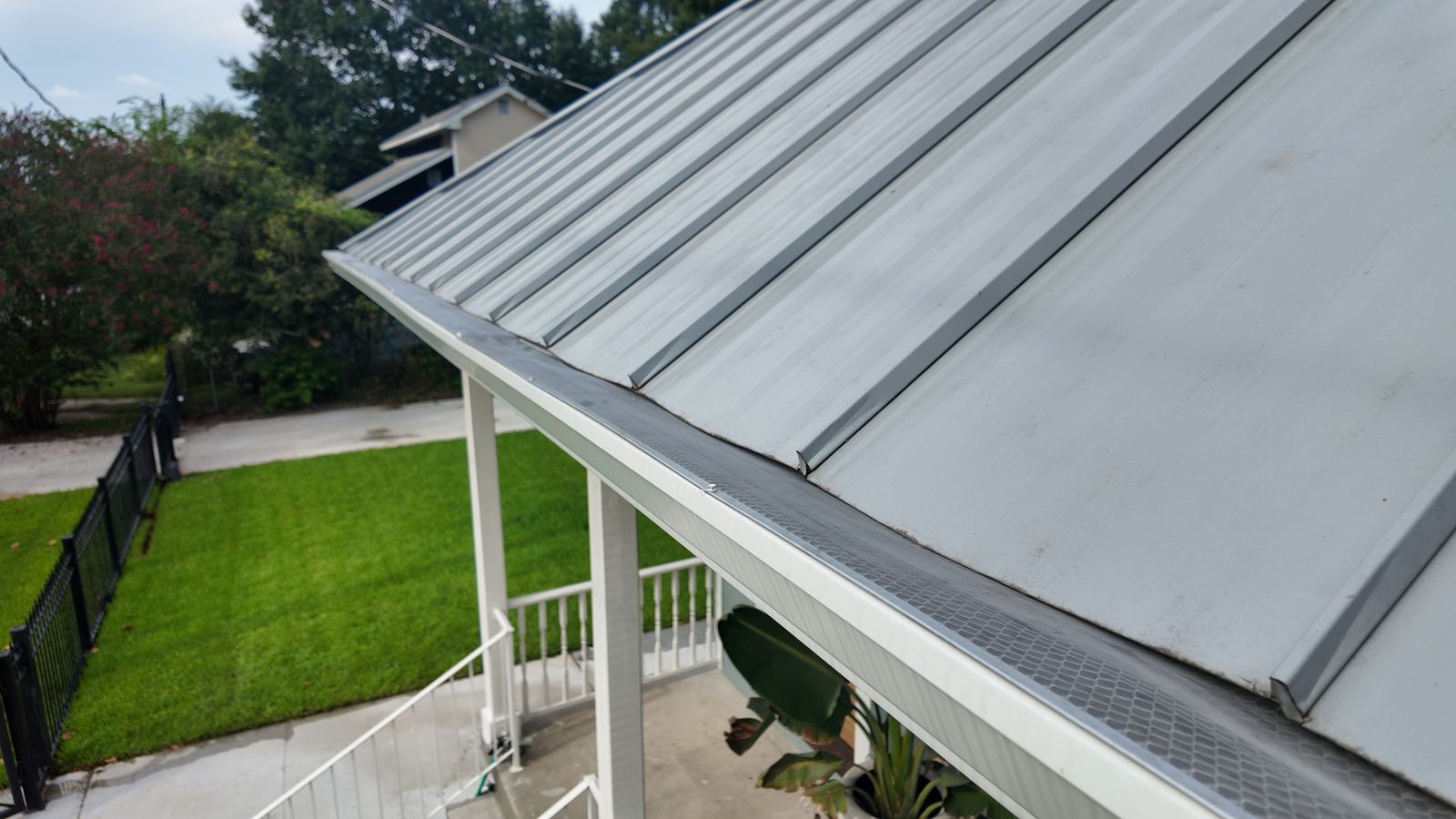
Stainless steel micro-mesh resists corrosion and holds its shape longer than standard aluminum mesh.
Maintenance
Maintenance and Access Differences
"Maintenance-free" is one of the most common claims in gutter guard marketing, and neither guard type fully lives up to it.
Cleaning Micro-Mesh Guards
Micro-mesh guards need less frequent cleaning than an open gutter, but the mesh screen itself still needs attention, particularly in a climate with heavy pollen, oak catkins, or fine organic debris that can coat the mesh weave and slow water flow. A soft brush or a garden hose from the ground typically clears buildup off the top of the mesh without requiring the gutter itself to be opened up the way an uncovered gutter would.
Why Reverse Curve Guards Are Harder to Access and Clean
This design is harder to access and clean specifically because any debris or sediment that does make it through the narrow slot can sit inside the gutter channel, hidden under the solid cover, where it can't be seen or brushed off from the ground the way surface debris on a micro-mesh guard can. Clearing that buildup usually means removing sections of the cover itself, which is a bigger job than wiping down an exposed mesh screen.
What "Maintenance-Free" Marketing Doesn't Tell You
Biofilm Is the Real EnemyNeither guard type eliminates gutter cleaning entirely, and this is where a lot of "maintenance-free" marketing overstates reality. Biological growth — algae, moss, and biofilm — grows on almost any damp surface given enough humidity, and a year-round humid climate gives it plenty of opportunity on both guard types. Biofilm buildup on a micro-mesh screen can reduce water flow through the openings well before the mesh looks visibly dirty from the ground, and standard mesh without an antimicrobial or copper-based finish is more susceptible to this than premium stainless steel mesh systems. The honest answer is that both guard types still need you to clean your gutters on an occasional inspection-and-light-cleaning basis, just far less often than a completely open gutter would.
Cost & Warranty
Installation, Cost, and Warranty Considerations
Cost and installation requirements differ enough between the two guard types to matter for a real budget decision.
Professional Installation Requirements for Each Type
Every dollar figure in this section is a national or regional average, not a quote — actual cost depends on your home's linear footage, guard type, roofline complexity, and site access. Request a free estimate for exact numbers on your property.
Both micro-mesh and reverse-curve systems are typically professionally installed, since a proper fit against the existing gutter and roofline matters for both performance and warranty reasons. Micro-mesh systems generally clip or screw directly to the gutter lip and fascia with no roof contact required, while some reverse curve systems are designed to tuck slightly under the first row of shingles to seat the curve correctly against the roofline — a detail that matters considerably once the warranty question comes up below.
Cost Per Linear Foot and 10-Year Cost of Ownership
Micro-mesh gutter guards typically run $8 to $12 per linear foot installed for solid mid-range brands, with premium stainless steel systems reaching $15 to $45 per linear foot. Reverse-curve systems typically cost $15 to $30 per linear foot installed for generic systems, with the patented Gutter Helmet brand specifically often landing at the higher end of that range or above it. On the surface, micro-mesh is usually the more affordable gutter guard system, though the true 10-year cost of ownership also depends on how often each system actually needs cleaning and whether its debris-blocking performance holds up as well as advertised. The type of gutter guard you choose changes this math more than the brand name printed on the box.
Install Cost Per Linear Foot
Roof Warranty and Shingle-Lift Risks
Shingle manufacturers including several major national brands prohibit fasteners or hardware that penetrates or lifts shingle material, and this is directly relevant to gutter guard installation. Any installation method that drives a screw or nail through a shingle, or that requires slightly lifting the bottom row of shingles to seat a cover, can create a warranty exclusion for that section of roof — regardless of how well the gutter guard itself performs afterward.
How Improper Installation Can Void Your Roofing Warranty
Ask This Before You SignA gutter-mounted installation that clips or screws only to the gutter lip and fascia, with zero contact against the shingles, doesn't carry this risk. A reverse curve or mesh system installed by lifting or fastening through the first row of shingles does, and it's worth asking any installer directly which method they use before signing a contract — a five-minute question that can save a much larger dispute with a roofing manufacturer later if a leak claim ever comes up.
Micro-MeshZero Roof Contact
Clips or screws to the gutter lip and fascia only — no shingle penetration.
Reverse CurveSometimes Tucks Under Shingles
Some systems tuck under the first row of shingles, which is where warranty risk enters.
Gulf South Verdict
Which Guard Wins for Gulf South Homes?
Everything above applies broadly. Here's what changes once you're specifically weighing micro-mesh vs reverse curve gutter guards for a New Orleans or Emerald Coast home.
New Orleans: Live Oak and Magnolia Debris Meets Hurricane-Season Downpours
New Orleans doesn't have a single autumn "leaf season" the way most national buying guides assume. Live oaks drop leaves and small debris year-round rather than all at once, magnolias contribute their own broad, leathery leaves on top of that, and bald cypress adds a fall needle drop that behaves a lot like the pine needles covered earlier in this guide. That means a New Orleans roof deals with a fairly constant trickle of debris across most of the calendar rather than one predictable autumn cleanup window — which puts more of a premium on consistent, year-round filtration than a climate with one concentrated debris season would.
Why Micro-Mesh Outperforms During Wind-Driven Rain
Hurricane-Season PhysicsHurricane season adds a second variable most competitor content never connects to gutter guard selection at all: wind-driven rain. New Orleans' hurricane season runs roughly June through November, peaking in late August and September, and storms in that window regularly deliver rain at a steep angle rather than straight down. Since this design depends on water approaching the curve at something close to a predictable angle to trigger the Coanda effect correctly, wind-driven rain during a tropical system is exactly the condition most likely to overwhelm a reverse curve guard's grip on the water and send it sheeting past the gutter opening entirely. Micro-mesh's simple gravity filtration isn't dependent on approach angle the same way, which is a meaningful practical advantage for a home that sees wind-driven downpours several times a year rather than as a rare event.
Destin and the Emerald Coast: Salt Air, Tile Roofs, and Coastal Storms
Salt air accelerates corrosion on exposed metal, and that matters for gutter guards the same way it matters for the gutters themselves on a Destin or Emerald Coast property within the first mile or so of open water. It also interacts with roof type: concrete and clay tile roofs, common on coastal Florida homes, shed water differently off the tile profile than a shingle roof does, which can affect how evenly water reaches either guard type along the gutter's length.
Material and Fastener Choices That Resist Corrosion
Stainless steel mesh resists salt-air corrosion considerably better than standard aluminum mesh or an uncoated aluminum reverse curve cover, and stainless steel fasteners hold up longer than standard-grade hardware within that first mile of salt exposure. For a coastal Destin property, the material grade behind either guard type matters more than it would inland, since standard aluminum mesh gutter guards are made to a price point that doesn't account for sustained salt exposure the way a marine-grade stainless system does.
New OrleansWind-Driven Rain
Hurricane-season downpours arrive at a steep angle that can overwhelm a reverse-curve guard's grip on the water.
Destin / Emerald CoastSalt-Air Corrosion
Open-water salt exposure favors stainless steel mesh and stainless fasteners over standard aluminum.
Flood-Zone and Elevated New Orleans Homes: Drainage Considerations
Large parts of New Orleans sit at or below sea level and depend on an engineered pump system to move stormwater, which makes a home's own gutter and downspout drainage matter more here than in a city where gravity alone clears water quickly. Whichever guard type a homeowner chooses, it still has to let enough water flow through fast enough to keep pace with the gutter and downspout sizing underneath it — a guard that blocks debris perfectly but restricts flow too much simply shifts the overflow problem rather than solving it, which matters even more on a home where the surrounding drainage system is already working near capacity during a storm.
Installing Guards on Historic New Orleans Rooflines Without Damage
Historic New Orleans homes — shotgun houses, French Quarter and Garden District properties among them — often have settled rooflines, older fascia boards, and in some cases historic-district review requirements around visible exterior changes. A gutter-mounted guard installation that clips to the gutter and fascia without touching the roofing material is generally the safer choice on a historic roofline, both because it avoids the shingle-warranty risk covered above and because it doesn't require disturbing original roofing material that a historic district review board may have opinions about.

A gutter-mounted installation avoids disturbing original roofing material on historic New Orleans homes.
| Factor | Micro-Mesh | Reverse Curve |
|---|
| Mechanism | Direct filtration | Coanda effect / surface tension |
| Pine needles & fine debris | Consistent blocking | Can ride through the slot |
| Heavy rain performance | Stays consistent | Can fail past a rain threshold |
| Expected lifespan | 20–25 years (stainless) | 15–20 years |
| Install cost per linear foot | $8–$12 | $15–$30 |
| Access for cleaning | Surface-level | Hidden under the cover |
| Warranty risk | Zero roof contact | Some tuck under shingles |
| Best fit | Wind-driven rain, fine debris | Simple roofline, large leaf litter |
Full System
Pairing the Right Gutter Guard With Your Gutter System
A gutter guard is only as good as the gutter setup it's protecting, which matters more than most buying guides acknowledge.
Why Guard Performance Depends on Correctly Sized Seamless Gutters
Installing even the best gutter guard for your home on an undersized, poorly pitched, or already-leaking gutter setup doesn't fix the underlying problem — it just puts a nicer cover on top of it. A correctly sized seamless gutter setup gives either guard type a fair chance to perform as designed, since the gutter underneath isn't already fighting overflow or standing water before the guard ever comes into play. Choosing the right gutter system to pair a guard with matters just as much as picking the guard itself.
Protecting Your Roofing Warranty With a Coordinated Installation
Because the roof warranty risk discussed earlier depends entirely on installation method, having the same contractor handle both the gutter and the guard installation as one coordinated project reduces the chance of a fastener or lift point that voids coverage on either system. GuttersTech can evaluate your existing gutters, recommend the correct gutter guard for your home, and bundle the installation with roofing, siding, or soffit/fascia work as one project rather than treating the guard as an afterthought handled by a separate crew.
Frequently Asked Questions
Which guard type blocks pine needles better?
Micro-mesh blocks pine needles more reliably than reverse curve guards. A reverse curve guard's narrow intake slot can occasionally let clumped or individual needles ride through with the water film, while a properly sized micro-mesh screen simply can't pass anything larger than its mesh openings.
Do reverse curve guards work in heavy hurricane-season rain?
Not as consistently as micro-mesh. Reverse curve guards depend on surface tension and a fairly predictable rain angle, and heavy, wind-driven hurricane-season rain is exactly the condition most likely to overwhelm that mechanism and send water sheeting past the gutter opening.
Will installing gutter guards void my roof warranty?
It depends entirely on installation method, not the guard brand. Fasteners or lift points that penetrate or disturb shingle material can void a shingle manufacturer's warranty, while a gutter-mounted installation with zero contact against the roofing material generally does not.
How often do micro-mesh guards need cleaning in a humid climate?
Less often than an open gutter, but not never. Algae, moss, and biofilm can grow on a micro-mesh surface in a year-round humid climate and reduce water flow before the mesh looks visibly dirty, so an occasional inspection and light cleaning is still worth scheduling.
Which option costs less over 10 years?
Micro-mesh is usually less expensive both upfront, at roughly $8 to $12 per linear foot installed versus $15 to $30 or more for reverse curve systems, and over time, since its debris-blocking performance tends to hold up more consistently as it ages.
Schedule a Gutter Guard Consultation
Whether micro-mesh or reverse curve is the better gutter guard for your home comes down to your trees, your roofline, your storm exposure, and how the installation is actually done — not a generic national recommendation. GuttersTech can look at what's actually falling on your roof, evaluate your existing gutters, and recommend the correct gutter guard system installed properly, without putting your roofing warranty at risk.